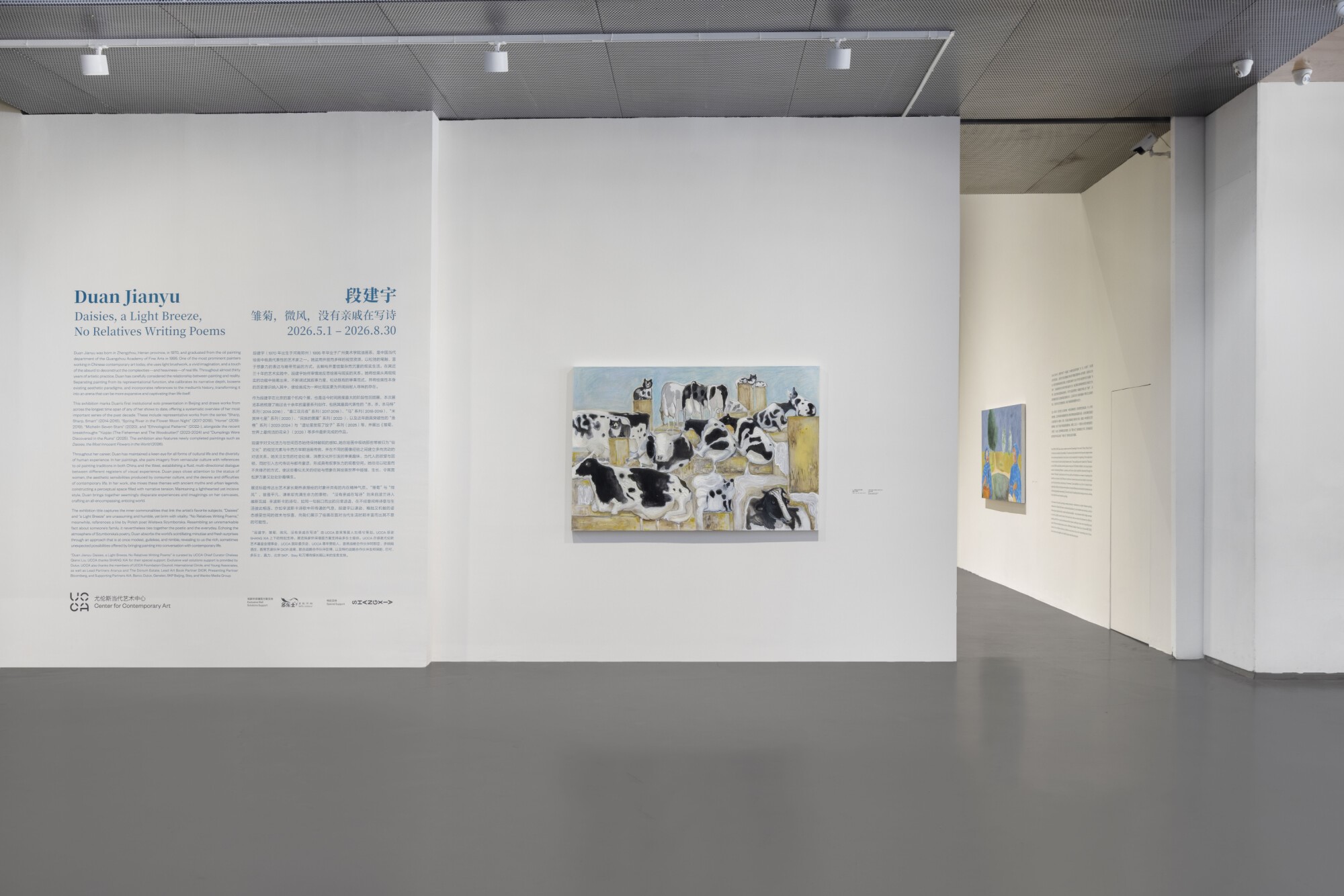
The title arrives like weather heard through an open window: Daisies, a Light Breeze, No Relatives Writing Poems. Its last phrase comes from Wisława Szymborska, whose plain speech often shelters a trapdoor. Duan Jianyu works similarly. Her paintings make room for the unimportant and slightly ridiculous, then wait for the hierarchy between important and unimportant to collapse.
UCCA Beijing’s exhibition, curated by Chelsea Qianxi Liu, brings together roughly fifty paintings, five groups of sculptures, painting installations and works on paper. It is Duan’s first institutional solo exhibition in Beijing and her most extensive presentation to date. The curatorial frame begins in the mid-2010s and moves through six sections: an account of ten years in which her loose, intertextual narratives became increasingly attentive to vernacular images, consumer desire, women’s bodily experience and painting’s own historical baggage.
“Vernacular” can be a treacherous museum word. It often turns whatever lies outside elite taste into material newly available for institutional appreciation. Duan’s paintings resist that conversion because they do not refine their sources. Shamate hairstyles, folk tales, internet language, commercial pictures and early Chinese and Western oil painting enter on unequal terms and remain visibly awkward together. The awkwardness is the argument. Culture does not circulate as a graceful exchange; it arrives copied, misremembered, cheaply printed and desired for the wrong reasons.
In the “Yúqiáo (The Fisherman and the Woodcutter)” paintings, figures inherited from classical Chinese culture lose the authority of allegory and return as ordinary people. Elsewhere, dumplings are discovered in ruins and a minimalist exhibition fails because there is too much milk. These titles are not captions for jokes. They loosen the obligation for painting to deliver a stable meaning. An image can be foolish without becoming empty, and historical without behaving respectfully towards history.
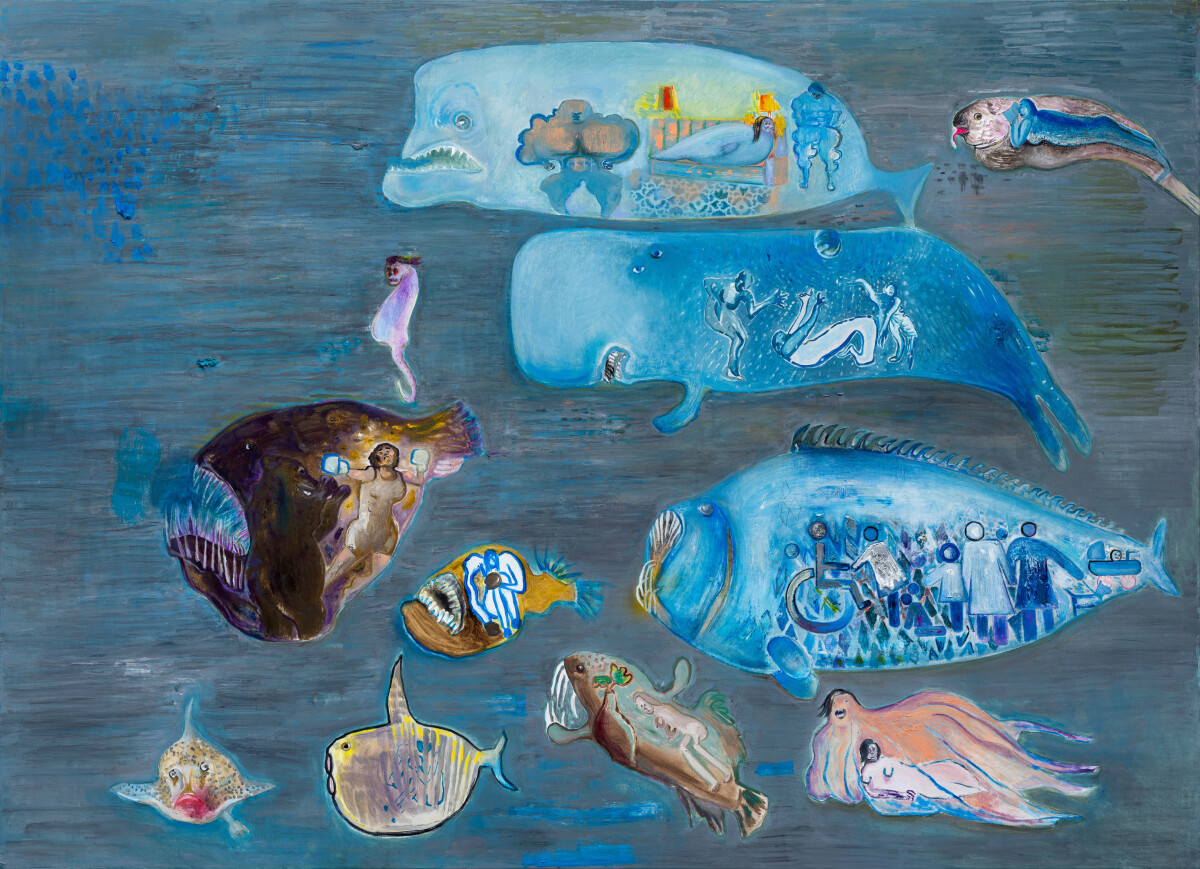
A Room of One’s Own (2026) borrows Virginia Woolf’s famous demand and turns it into an ecology of blue animals. Human scenes sit inside fish and whale-like bodies: a bed, a wheelchair, a cluster of figures, a person reading or resting. The room is no longer architecture but a creature that carries private life in its belly. Woolf’s room promised material independence; Duan’s is mobile, porous and shared with beings that may swallow or shelter it.
The work belongs beside Duan’s earlier attention to middle-aged women. In the “Facekini” series and Women Hiding in the Wardrobe to Avoid Chores (2020), female figures are not arranged for admiration. They are heavy, relaxed, self-occupied and sometimes deliberately unavailable. To hide from chores is a modest refusal, but refusal is precisely what domestic labour rarely permits. Duan makes withdrawal neither heroic nor shameful. It is simply one of the body’s tactics.
Liu’s survey gives these recurring gestures enough duration to be recognised as a practice rather than a succession of eccentric images. The six-part structure clarifies the shift from “Sharp, Sharp, Smart” through “Automatic Writing,” “Yúqiáo” and the new works. Yet clarification has a cost. Duan’s paintings thrive on false connections, interrupted stories and references that have slipped their proper category. A chronological-thematic route can make their disorder look developmental—as if every stray image had been moving patiently towards a museum retrospective.
The exhibition is more persuasive when it does not explain away that disorder. Sculptures interrupt the authority of the wall; small and large works refuse a single rhythm; the paintings keep producing details that exceed the section texts. Curating Duan requires a degree of losing control. The task is not to translate every cow, fish, basket or masked woman into a social symptom, but to preserve the moment when incompatible things recognise one another without becoming the same.
Duan’s ordinary world is not innocent. Consumer taste shapes it, gendered labour exhausts it, and cultural hierarchy decides which images count as serious. But she does not answer these conditions with solemnity. Her humour keeps judgement moving. At UCCA, the paintings remain sharpest when they appear to have wandered out of the curatorial argument and begun making relations of their own.
Editorial note: This critical desk review was written from UCCA’s official exhibition text, published work list and installation documentation. It does not claim first-hand attendance.