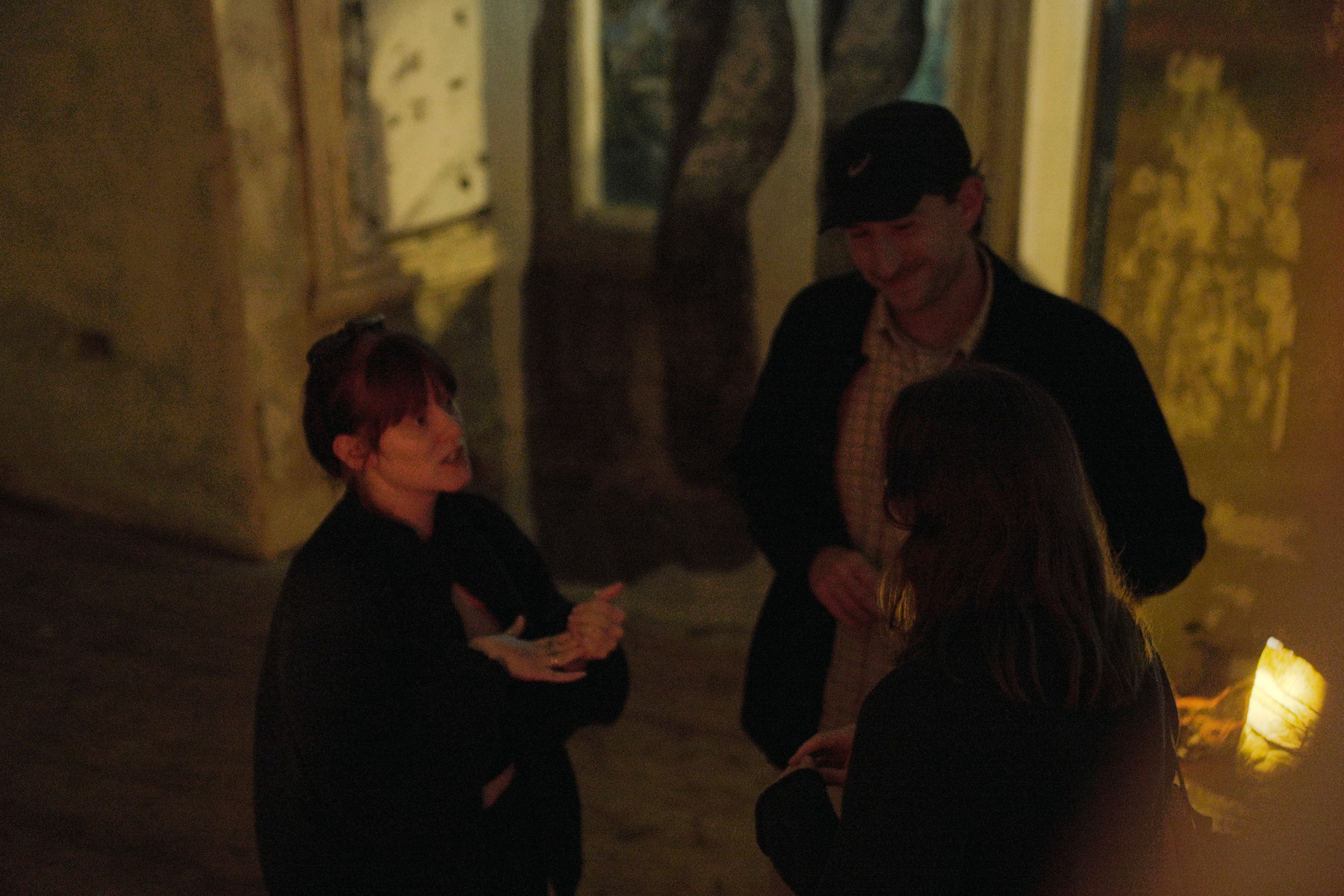
A photograph from Awakening shows three people talking in a darkened room. One holds out both hands; another bends towards them to listen. Behind the group, a projection falls across damaged plaster, while a light on the floor catches the edge of something that might be a sculpture. It is not a photograph that explains an exhibition. It records a temporary closeness—the sort that disappears when the lights come up.
Awakening was a one-day event at Safehouse 1 & 2 in Peckham on 7 October 2024. Curated and produced by Jiaying Zou through Chimimora, it moved between installation, moving image, sound, performance and live music. Safehouse is not a white cube. Its stained walls, worn surfaces and narrow domestic rooms carry the memory of use; they are never neutral behind what is placed there. The building denied the clean separation on which group exhibitions often depend. A sound travelled; a projection crossed an old wall; visitors became silhouettes inside someone else’s work.
The title was less precise. “Awakening” carries a familiar promise of passage—from darkness to light, dormancy to consciousness—and the exhibition statement sometimes followed that language too readily. Transformation and self-realisation are hospitable ideas, but their hospitality can become indiscriminate: almost any work can enter, and very little is asked to change once it is there. What survives in the documentation is stranger and less affirmative.
Ella Potts called her work Listening to the Non-Human. Fangmeng Liu’s Pills brought the ambivalence of medicine into the room: a pill may heal, regulate, sedate or discipline. In Nima Shafiani’s October opens its eye, seeing is seasonal and slightly ominous, not a clean arrival at knowledge. Rosalie Oakman’s Upside Down – Body unsettled the upright body assumed by the exhibition’s language of growth. Seb Bradshaw’s titles—Selkie Shoes, Kelp Window, Selkie, Our Lady of the Isles—opened another route through folklore, migration and marine life. Read together, these works made awakening feel bodily, partial and not necessarily welcome.
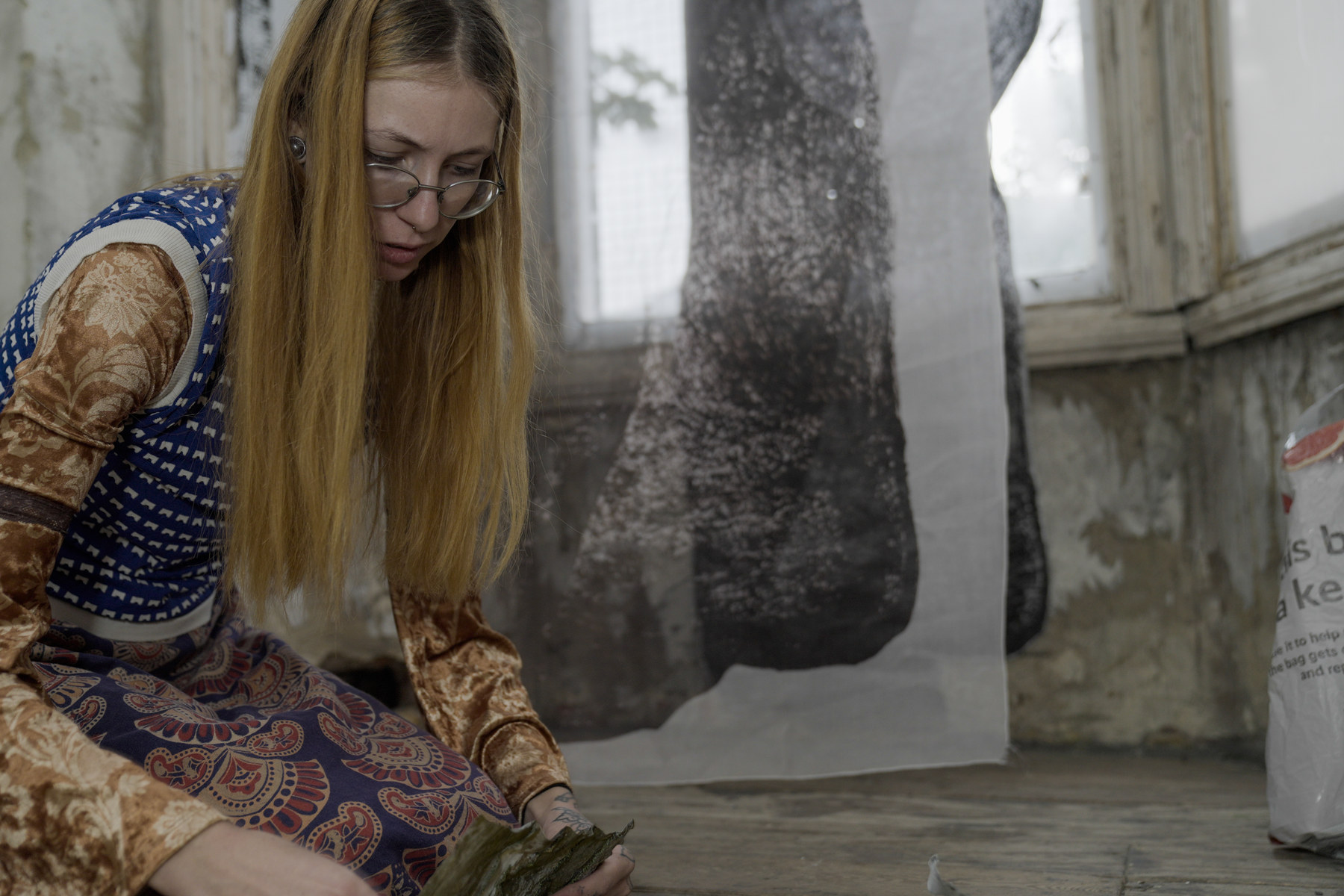
Zou’s curatorial method was to let these positions share air rather than force them into a sequence. Han Gao’s live music made looking porous; works concerned with bodies and non-human perception pulled attention away from the wall. This suited both the building and Chimimora’s emphasis on gathering. But a crowded, informal exhibition still has a structure, even when that structure is presented as encounter. Someone decides which sounds overlap, which object occupies a threshold, and whose work is legible in the half-light.
The photographs suggest that this density produced an evening with a palpable social temperature. They also reveal its cost. Individual works are difficult to reconstruct, and the present project page moves between installation views and titles without a floor plan or consistent image credits. Atmosphere can be generous to a collective and ungenerous to an artist: it remembers how a room felt while allowing the particular work to recede.
Zou occupied a further double position, exhibiting Aquarium and Art gallery while curating the show. There is no reason to treat the artist-curator as an exception in an artist-led project; such roles have long overlapped. Yet the overlap changes the balance of a room. It would be useful to know how her works were placed in relation to those she selected, and whether they were permitted to speak in the same register. The surviving documentation leaves that question open.
The exhibition found a second form after it closed. Produced with the French independent publisher La chaise jaune, the Awakening zine gathered photographs by Yang Zhang and Xiaoyan Li on paper made from agricultural waste. This modest material decision did more than the rhetoric of renewal: residue became paper; an event became an object that could travel. The publication also fixed a list of thirteen participating artists, giving names and duration to an evening built around impermanence.
What remains compelling about Awakening, two years later, is not its promise of enlightenment. It is the image of bodies negotiating an already marked space—listening, ingesting, turning over, becoming animal, briefly visible in one another’s light. The exhibition was most alive where its title lost authority and the works began to disagree with it.
Published 20 August 2026 as part of the 2025 Founding Research Archive. This retrospective essay was written from the exhibition’s published texts, photographs, work list and subsequent zine. It does not claim first-hand attendance. Artist names follow the zine’s published record.